
Which 3D Printer Is Best for UK Secondary Schools?
Published on 16/03/2026 in Secondary
A Practical Guide for D&T Departments
Introducing 3D printing into a Design & Technology department opens exciting opportunities for students to test ideas, prototype designs and develop real engineering skills. The key challenge for many schools isn’t whether to adopt 3D printing. It’s choosing a printer that is reliable, safe and practical for classroom use.
Two increasingly popular options are the Bambu Lab P2S Combo and the Bambu Lab H2D 3D Printer. Whilst both share similar motion systems and automatic material handling (AMS) capabilities, they are designed for slightly different types of school environments.
Understanding these differences helps departments choose the printer that best supports their curriculum and technician workload.
Why 3D Printing Matters in D&T
3D printing allows students to:
Move quickly from CAD design to physical prototype
Test and refine ideas through iterative design
Develop practical engineering and manufacturing skills
Explore modern digital fabrication technologies
For technicians and teachers, the ideal machine balances ease of use, durability and flexibility so it can support multiple classes throughout the week.
What is the difference between the Bambu P2S vs H2D 3D printer?
Bambu P2S | Bambu H2D | |
|
| |
Best for | Reliable everyday printing at KS2–KS5 | Advanced fabrication capabilities and greater versatility at KS3 and above |
Choose if your priority is |
|
|
Nozzles | Single | Dual |
Build volume | 256 × 256 × 256 mm | 340 × 320 × 325 mm |
Max nozzle temperature | 300°C | 350°C |
Heated chamber | Passive enclosure | Actively heated up to 65°C |
Multi‑colour capability | Multi‑filament with AMS | Up to 25 colours with accessories |
Additional functions | 3D printing | Optional laser cutter & material cutter |
The Bambu P2S: Reliable and Practical for Classroom Use
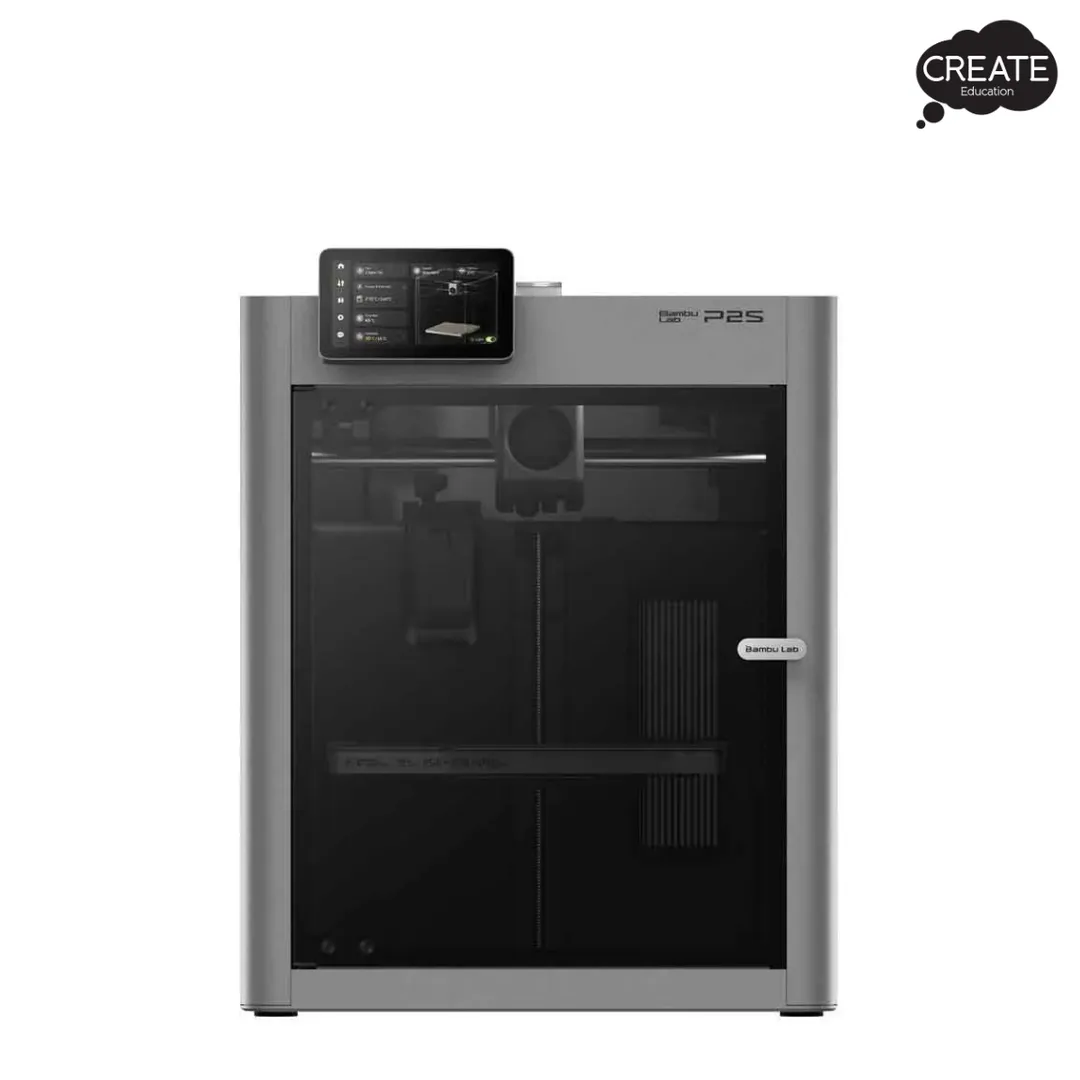
Bambu Lab P2S Combo
For many secondary schools, the P2S provides everything needed to run a successful 3D printing programme.
Key advantages
Straightforward single-nozzle design
The single-nozzle configuration simplifies operation and reduces maintenance demands. In a busy workshop environment, fewer moving components often means fewer interruptions.
Build volume suitable for most student projects
With a 256 × 256 × 256 mm build volume, the printer easily accommodates typical school projects such as product prototypes, mechanisms and small assemblies.
High-temperature capability
The nozzle can reach 300°C, allowing it to print common classroom materials such as PLA, PETG and ABS, but also PA6 and PA16 (Nylons), and some “CF” and “GF” materials, which are normal materials with chopped up carbon fibre or glass fibre to give the materials extra strength, cosmetic appearance, or impact resistance.
Enclosed design
Although it does not actively heat the chamber, the enclosure helps maintain internal temperatures and improves print consistency. It has an active vent to keep the chamber cool when required, or allow it to warm up when that’s better.
When the P2S works best
The P2S is particularly well suited to:
KS3 design and modelling projects
GCSE product design prototypes
Departments introducing 3D printing for the first time
Classrooms where simplicity and reliability are priorities
For many schools, this type of printer becomes a dependable daily workhorse for student prototypes.
The Bambu H2D: Advanced Capability for Fabrication and Innovation
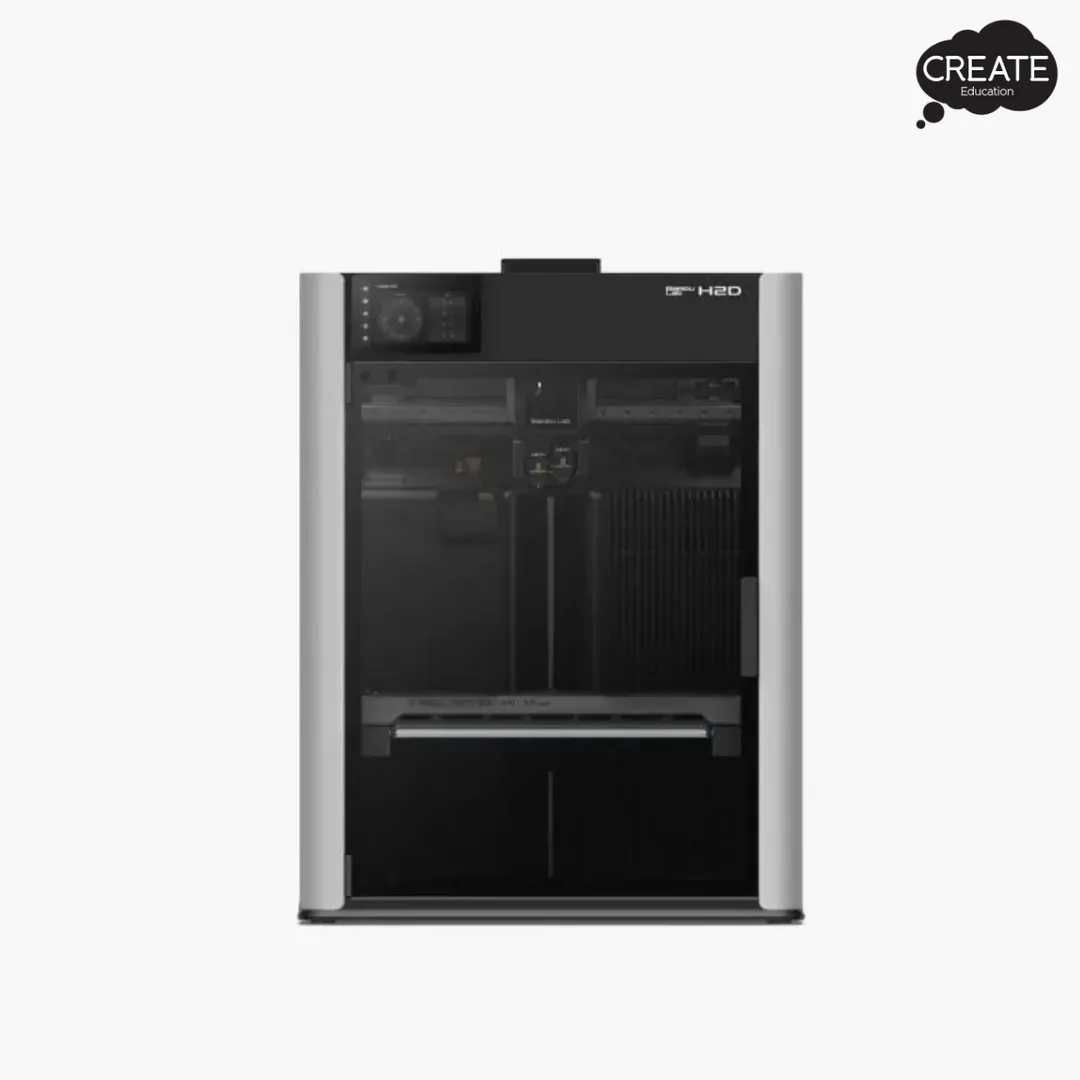
Bambu Lab H2D 3D Printer
The H2D is designed as a more advanced fabrication platform, offering capabilities that go beyond standard 3D printing.
Dual-nozzle system
The H2D uses two nozzles, enabling:
Multi-material printing
Complex support structures
Multi colour prints
This allows students to experiment with more advanced design ideas and materials.
Larger build volume
The H2D provides a significantly larger print area of approximately 340 × 320 × 325 mm, allowing larger prototypes or multiple student parts to be printed simultaneously.
Heated build chamber
An actively heated chamber (up to around 65°C) improves reliability when printing advanced materials that would otherwise warp. This can be useful for engineering plastics or more demanding projects.
Multi-colour capability
With the right accessories, the system can handle up to 25 filament colours, opening up opportunities for visually complex models and demonstrations.
Hybrid fabrication options
One of the most distinctive features is that the printer can be upgraded with additional modules such as:
Laser engraving
Laser cutting
Digital material cutting
This effectively turns the machine into a compact digital fabrication workstation, though additional filtration equipment is required for safe use in educational settings.
When the H2D works best
The H2D may be a good choice for:
Advanced GCSE or A-level design projects
Engineering or robotics clubs
Departments exploring maker-space style learning
Schools wanting a single platform that supports multiple fabrication technologies
Supporting Confident Technology Adoption
When new technology works reliably, it quickly becomes a natural part of classroom learning. The most successful school deployments focus on simple workflows, dependable equipment and technician confidence.
With the right printer in place, students can:
Prototype ideas within a single lesson cycle
Evaluate and refine their designs
Develop practical engineering skills that support modern manufacturing and design industries
For many departments, 3D printing becomes one of the most engaging tools available. Turning digital ideas into physical outcomes students can test, improve and proudly present.
Frequently Asked Questions – Accordion at the bottom of the blog
What type of 3D printer is best for schools?
FDM printers are typically the most suitable for education because they are safe, reliable and use affordable filament materials.
Do schools need dual-nozzle 3D printers?
Not necessarily. Single nozzle printers are simpler to maintain and are often ideal for classroom use. Dual nozzle printers are helpful when printing multiple materials or colours.
What materials are safest for school 3D printing?
PLA is generally the most common school material because it prints at lower temperatures and produces minimal odour compared with some engineering plastics.