
Chemistry open evening inspiration
Published on 11/07/2025 in Secondary

Open evenings. What better way to showcase the science department and stimulate enthusiasm for learning about Chemistry?
It can be hard to choose which Chemistry demonstrations to do, such is the breadth of the subject. To help you out, our in house technicians have picked their most engaging demonstrations for Chemistry department open evenings.
KS3 Chemistry open evening ideas
Chemistry lends itself well to visual demonstrations, which not only are bright and colourful, but show how Chemistry is intertwined in our everyday lives.
Flame tests (Demo only)
Demonstrate the different flame colours produced by burning metal salt in a blue bunsen flame. Choose several different metal chloride salts, such as lithium (red), copper (green), sodium (yellow), potassium (lilac). Remember your personal protective equipment, bottles for storing metal salts and inoculating loops to safely hold the metal salts in the flame.
You will need
Safety goggles
Bunsen burner
Wire holder
Clear glass bottle with screw caps – 30ml
Hydrochloric Acid 1.0M - 1L
Copper (II) Chloride-2-Water - 250g
Lithium Chloride Anhydrous - 50g
Potassium Chloride - 500g
Sodium Chloride - 1kg
CLEAPSS HazCards: 27A, 47A, 47B
Simple chromatography
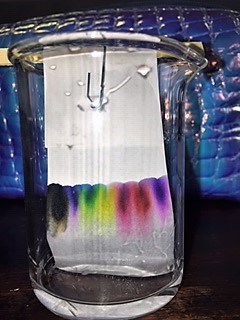
Let visitors try their hand at some simple ink chromatography using water-based felt-tipped pens. Cut and measure some 10cm strips of chromatography paper and draw a pencil line 2cm up from the bottom of the chromatography paper strip in advance.
Ask the visitors to draw blobs of ink along the pencil line using different colours of the felt-tipped pens. Then wind the chromatography paper strip around a straw or wooden splint as a hanger. Lower the chromatography paper strip into a clear plastic cup or 250ml beaker containing a small amount of water, so that the bottom edge of the paper is just touching the surface of the water. The inks will start to separate up the paper into various colours.
You could also do this demonstration on a circular filter paper, to create a pattern.
You will need
Chromatography paper roll
Circular filter paper
Clear plastic cups or 250ml beaker
Water-based felt-tipped pens
Pencils
Wooden splints or straws
Testing household substances with universal indicator
This is a great way to demonstrate how Chemistry is involved in our everyday life. First, choose various household substances and dispense into labelled dropping bottles. You will also need to prepare a full range universal Indicator solution in another set of labelled dropping bottles, plus spotting tiles and colour charts for your particular universal indicator solution
Visitors can add drops of universal indicator to the wells of a spotting tile, then add drops of each of the household substances to each of the wells to see whether the substances are acidic or alkaline. Universal indicator paper could also be made available for use. A washing up bowl will also be required for discarding used spotting tiles.
Remember, visitors must wear safety glasses and should wash their hands after completing the activity.
You will need
Spotting tiles
Full range universal indicator solution
Washing Up Bowl
Full range universal indicator paper
Bollé Safety Slam Clear Spectacles Pack of ten
Various household substances, for example vinegar, lemon juice, toothpaste, washing up liquid, hand soap, bicarbonate of soda and milk of magnesia
KS5 Chemistry open evening ideas
At KS5, students have chosen to study Chemistry to a deeper level. This is the time to demonstrate the skills required for a career involving Chemistry; and to show the huge range of learning opportunities available to them.
Titrations
Titration skills are developed during the start of A-Level Chemistry courses. An acid-base titration is the most straightforward to set up. Several stations with labelled burettes can be made available alongside a large volume of prepared reagents. Distilled water bottles should also be available.
You will need
Glass Burette (Class B) - 50ml
Plastic funnel
Burette stand
Acrylic tiles
Labelled distilled water bottles
Hydrochloric Acid 36% - 1L
Sodium Hydroxide pellets - 500g
Phenolphthalein Solution in Ethanol - 500ml
CLEAPSS HazCards: 32, 47a, 91a
CLEAPSS Document GL321 Titration Technique
Oscillating clock (Briggs-Rauscher Method)
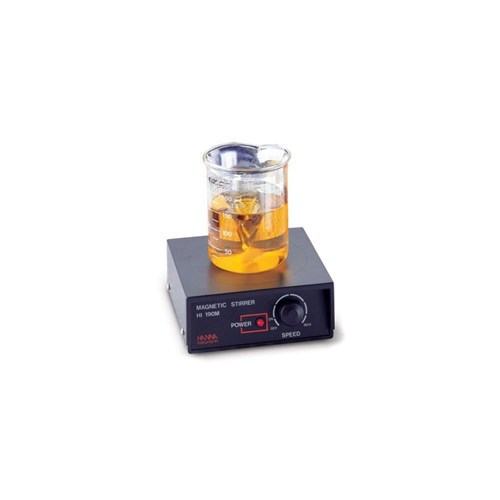
An excellent visual demonstration to show chemical reaction kinetics. Four solutions are added to a beaker in a specific order and placed on a magnetic stirrer. The solution changes from clear to dark blue/black and back again. This demonstration can be left running on a magnetic stirrer for a few minutes and will amaze visitors with its automatic colour change.
You will need
250ml glass beaker
Magnetic stirrer
25ml measuring cylinder
3ml disposable pipettes
Hydrogen Peroxide (20 vol) - 1L
Potassium Iodate(V) - 100g
Sulfuric Acid 1.0M AR - 1L
Starch, soluble - 500g
Propanedioic Acid - 25g
Manganese (II) Sulfate-1-Water - 250g
CLEAPSS Document PP108 Oscillating Reactions Briggs-Rauscher BR Method
Iodine clock
A good visual experiment to show chemical reaction kinetics. Four colourless solutions are mixed together in a conical flask. After around 20 seconds, the production of Iodine causes the starch indicator to turn the solution dark blue. The volumes of each of the solutions can be varied to increase or decrease the rate of the reaction.
You will need:
25ml measuring cylinder
10ml measuring cylinder
3ml disposable pipettes
100ml conical flask
Starch, soluble – 500g
Sodium Thiosulfate
Potassium Persulfate
Potassium Iodide
CLEAPSS HazCards: 40C, 47B, 95A, 95B
CLEAPSS Document PP092 Iodine Clock Reactions Iodide Persulfate Method
Get advice about Chemistry demonstrations for open evenings
If you have any questions about setting up Chemistry demonstrations for open evening, please contact our Technical Support Team via techsupport@philipharris.co.uk